
Maytag Multi-Motor Engines

Maytag Upright Engine 1915-1923
- Fuel Ratio: 1/2 pint or 8 ounces of oil to 1 gallon of gas- For All Maytag-Multi Motors
- Point Gap: 1/32 inch, or thickness of a dime
- Plug Gap: .024
- RPM: Approx. 1,000
The first self powered wringer washing machine was the Model 43. The first engines came with a battery powered ignition as shown above. In 1918 a magneto ignition system was added with the Model 44.
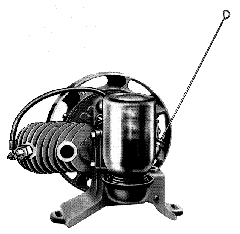
Maytag Fruit Jar Engine, September 1921 Through March 1923
The Maytag Fruit Jar Engine is arguably the most collectible of all the Maytag engines.
One of the engines claim to fame is they were Maytags first production horizontal engine. And secondly and most important their unique feature from which they derive their name is a Ball Mason canning or fruit jar was used as the fuel tank. Despite rumors of an original Jar being marked Maytag for the engine none has ever been shown to anyone I know. Maytag did make some Canning jars during the war but they were not for use on the engines. There are no records we are aware of to suggest that anything other then the commonly available Ball Mason One Quart jar of the day was used.
According to calculations based on the dates of specification sheets and on production records, a total of between 2200 and 3400 Fruit Jar MULTI-MOTORS were produced. Fruit Jar Engine serial numbers are generally found in the #99860 through #111301. The Fruitjar engines were built during the last two years (1921-1923) of Upright production. Their production was ceased due to the concerns of fire hazard. Its also said that Maytag took back engines to be destroyed.
The Fruitjar engine used the same Johnson magneto type as the 1/2hp Upright. Although a couple Fruitjar engines are known to have the Quick Action Magneto. If this was production or a later field retro-fit as a repair is not known.
Be warned! Due to their value, there have been Replica engines made.
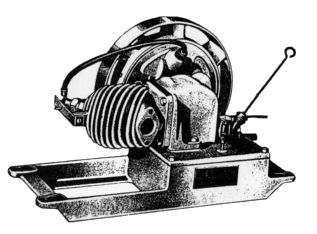
Maytag Later Model 82
Single main bearing Multi-Motor. The name Model 82 comes from the model of washer it was used on. The model 82s used a Johnson magneto. But a few beginning in June 1927 were produced with Bosch FY-ED2 magnetos. There were both 11 and 9 fin cylinder model 82 Multi-Motors. The 11 fin cylinder came first on the 82 then at about the time of the change to the long frame S-223 tank this changed to the 9 fin cylinder. So some long frame engines are seen with 11 fins and some short tank engines with the 9 fin as well. Circumstantial evidence indicates that around 15,680 11 fin multi-motors were produced.
Also the first model 82 multi-motors came with the S-216 fuel tank that looks similar to the late Upright fuel tank. Then shortly after they changed to the S-223 long frame fuel tank. There are at least 3 and maybe more notable variations to the S-223 tank in evidence thru production. The early model 82 Multi-Motor was enameled blue. Beginning April 20,1926 with "Washer" # 56333, Subsequent model 82 Multi-Motors were enameled green.
The Upright, Fruitjar and Model 82 engines shared the same basic E type carb with some minor variations thru prod

Maytag Double Main Bearing Multi-Motor (Model 92), August 1927 Through August 1937
PLEASE NOTE- Modern day collectors refer to all engines of this style as the Model 92- which is incorrect! The model 92 refers to the model of washer the engine came off of. This motor was used on many different washers. The model is stamped on the bottom of the caution plate found above the carburetor or on the kick pedal gear guard. It will still be referred to as the 92 in this information to limit confusion.
- Point Gap: .020th
- Plug Gap: .020th
- RPM: Approx. 1,050
Maytag Introduced The model 92 single cylinder horizontal kick start in August-September 1927 Assembly #3902 It was rated 3/4 h.p. and is a 2 Cycle design engine with a 2 1/2" bore and 2"stroke. The Bosch FY-ED4 magneto was standard on the model 92. The model 92 was the first Maytag washer motor to have as part of the engine a kick pedal for starting. The kick pedal of the model 82 is earlier but it was part of the washer not the engine. The 92 was used on models 92, 62, B, G, 16, 26, 31, 11, N11, 110, 19, 11.111 and 33 washers. The engine was adaptable to each model of washer by changing the fuel tank.
The fuel tanks came in three versions, # S-231 for the model 92 and model B washers, # S-279 for the model, G, 16, 19, 26, 11.111 & N-11 washers and # S-284 for model 31, 33 and the Toy Racer. There is a fourth tank also part numbered S-279 and it is different from the commonly found S-279 tank. What the reason for this variation was and why a unique part number for it was never assigned is not known. This odd tank is hard to find.
Interesting variations appear on these engines with two being of significant interest. The earliest feature or variation earns the early 92 engines their nick name, The Side Exhaust. There were two exhaust manifolds used on these engines. The S-252 "Elbow connection" as Maytag called it or side exhaust manifold as its called today and is the earliest version and was used for only a short period of time from August 1927 to March 1928. The S-260 is the second version and replaced S-252 at approximately 266000. The side exhaust engines are eagerly sought after. There are other features specific to the side exhaust that are found only on an early 92. But too numerous to go into here.
The second major variation is the model 19 found late in production 1936 to 1937. The Model 19 has a different Kick pedal, segment gear and segment cover. Part numbers S-295 / S-296 / S-297 The pedal and segment gear resembled those of the later twin cylinder engines. This change was necessary to adapt the engine to the model 19 Washer.
There were two caution plates and a variation. Part #12903 is the first for the models 92 and began at about 281000 and had the 92M embossed in it. And later #13474 this plate had blank spaces to allow for the hand stamping of the various model numbers. Then for the model 19 part #13474 was modified by cutting the mounting tabs off the bottom of the plate so it would fit under the Maytag Script of the S-297 segment cover. The caution plates did not specify a model of the engine but rather was the model tag of the washer that particular engine was installed on.
There are many other differences in the production run of the model 92, but these will do as a highlight.
See the book Maytag Multi-Motors by Larry and Marge Benton for more interesting information on these engines. Available through the Maytag Collectors Club.
Serial Numbers - Model 92 Maytag Multi-Motor
219612 - 804444 August 1927 to August 1937
219612 ~ 219716 August 1927
219717 ~ 224078 Sept 1927
224079 ~ 248522 Oct 1 to Dec 23 1927
248523 ~ 266616 Jan 1 to Mar 30 1928
266617 ~ 288023 Apr 1 to Jun 30 1928
288024 ~ 313380 Jul 1 to Sep 29 1928
313381 ~ 326800 Oct 1 to Dec 14 1928
326801 ~ 341047 Jan 1 to Mar 30 1929
341048 ~ 367844 Apr 1 to Jun 30 1929
367845 ~ 393871 Jul 1 to Sep 30 1929
393872 ~ 411464 Oct 1 to Dec 30 1929
411465 ~ 423466 Jan 1 to Mar 31 1930
423467 ~ 445246 Apr 1 to Jun 30 1930
445247 ~ 455981 Jul 1 to Sep 30 1930
455982 ~ 460999 Oct 1 to Dec 11 1930
461000 ~ 468570 Jan 1 to Mar 31 1931
468571 ~ 475920 Apr 1 to Jun 24 1931
475921 ~ 479073 Jul 1 to Sep 30 1931
479074 ~ 480624 Oct 1 to Dec 11 1931
480625 ~ 483288 Jan 1 to Mar 31 1932
483289 ~ 485988 Apr 1 to Jun 30 1932
485989 ~ 489057 Jul 1 to Sep 30 1932
489058 ~ 489952 Oct 1 to Nov 23 1932
489953 ~ 491053 Dec 1 1932 to Feb 28 1933
491054 ~ 492143 Mar 1 to Apr 30 1933
492144 ~ 494698 May 1933
494699 ~ 498505 Jun 1933
498506 ~ 502435 Jul 1933
502436 ~ 509415 Aug 1933
509416 ~ 513840 Sep 1933
513841 ~ 518330 Oct 1933
518331 ~ 520840 Nov 1933
520841 ~ 523885 Dec 1933
523886 ~ 528185 Jan 1934
528186 ~ 532800 Feb 1934
532801 ~ 539830 Mar 1934
539831 ~ 549540 Apr 1934
549541 ~ 560352 May 1934
560353 ~ 565855 Jun 1934
565856 ~ 569820 Jul 1934
569821 ~ 574545 Aug 1934
574546 ~ 578594 Sep 1934
578595 ~ 585355 Oct 1934
585356 ~ 589675 Nov 1934
589676 ~ 593050 Dec 1934
593051 ~ 599090 Jan 1935
599091 ~ 605590 Feb 1935
605591 ~ 613470 Mar 1935
613471 ~ 622686 Apr 1935
622687 ~ 632576 May 1935
632577 ~ 640740 Jun 1935
640741 ~ 648800 Jul 1935
648801 ~ 657525 Aug 1935
657526 ~ 665030 Sep 1935
665031 ~ 673005 Oct 1935
673006 ~ 677230 Nov 1935
677231 ~ 680050 Dec 1935
680051 ~ 685925 Jan 1936
685926 ~ 691345 Feb 1936
691346 ~ 698100 Mar 1936
698101 ~ 705778 Apr 1936
705779 ~ 712948 May 1936
712949 ~ 720742 Jun 1936
720743 ~ 729390 Jul 1936
729391 ~ 738134 Aug 1936
738135 ~ 745646 Sep 1936
745647 ~ 751574 Oct 1936
751575 ~ 757022 Nov 1936
757023 ~ 760247 Dec 1936
760248 ~ 766040 Jan 1937
766041 ~ 771177 Feb 1937
771178 ~ 776356 Mar 1937
776357 ~ 781997 Apr 1937
781998 ~ 788735 May 1937
788736 ~ 794760 Jun 1937
794761 ~ 803840 Jul 1937
803841 ~ 804444 Aug 1937

Maytag Twin Model 72
PLEASE NOTE- Modern day collectors refer to this style of engine as the 72, which is incorrect. Maytag called it the twin cylinder Maytag Multi-Motor. The Model 72 or 72D refers to the number stamped on the ignition baking plate by Eisman Magneto Company- no reference to a Maytag number. Twin engines can also be found with Wico ignition.
810000 - 838900........................1937
838901 - 879229........................1938
879230 - 911945........................1939
911946 - 941754........................1940
941755 - 970789........................1941
970790 - 979846........................1942
May 1942 through July 1945 no production due to World War II.
979847 - 983497........................1945
983498 - 1017096.......................1946
1017097 - 149199X......................1947
149200X - 182645X......................1948
182646X - 193437X......................1949
193438X - 199242X......................1950
199243X - 203424X......................1951
203425X - 205427X......................1952
Maytag numbered the model 92 and 72 consecutively with no recognition of the variety of styles each model had.